
Cyber incidents affecting critical infrastructure are often described as discrete events. An issue emerges in one organisation, is investigated locally, and addressed within that environment. When similar activity surfaces elsewhere soon after, it is frequently treated as unrelated.
In practice, threat activity often appears across multiple domains rather than remaining confined to a single organisation or sector. The challenge for executive teams and decision makers is understanding when individual signals point to something more widespread taking shape.
Why Threats Move Across Sectors, Not Just Within Them
Australia’s critical infrastructure operates as an enmeshed ecosystem, where organisations may span multiple industries, but often rely on the same platforms, vendors, operating models, and third parties.
This creates conditions for similar risks to surface across environments in close succession. An initial signal might appear limited when viewed through a single organisational lens, meaning it is logged, monitored, or deprioritised based on local impact alone. But without broader context, it is difficult to determine whether that activity is isolated or part of a developing pattern.
This is not a gap in effort or capability. Most organisations already collect significant volumes of security information. The limitation lies in visibility beyond their immediate operating environment.
The Problem With Single-Sector Interpretation
When threat intelligence is assessed within narrow boundaries, patterns take longer to identify. Signals that appear routine or low risk in one sector can take on greater significance when similar behaviour is observed elsewhere.
For leaders, this creates uncertainty. Decisions about prioritisation, escalation, and investment are made without a clear view of how activity is evolving across the wider landscape. Risk can appear manageable until they escalate, not because it has changed suddenly, but because the broader context was never visible.
Over time, this reinforces reactive decision-making. Action is taken once – impacts are clear locally, rather than when early indicators suggest a trend is emerging.
How Cross-Sector Visibility Changes Understanding
Cross-sector intelligence brings together insights from multiple environments, allowing emerging activity to be assessed in context. Techniques observed in one sector can be compared against signals from others, helping patterns surface earlier and with greater clarity.
This does not require sharing sensitive internal details. Instead, it relies on structured intelligence sharing focused on behaviours, techniques, and indicators that may have broader relevance.
Shared intelligence does not mean increasing alert volume or complexity; it means improving context. Cross-sector intelligence helps leaders understand which signals matter, why they matter, and how they fit into a broader picture.
As the critical infrastructure sector becomes more interconnected, the ability to recognise patterns beyond organisational boundaries is a practical requirement for effective governance.
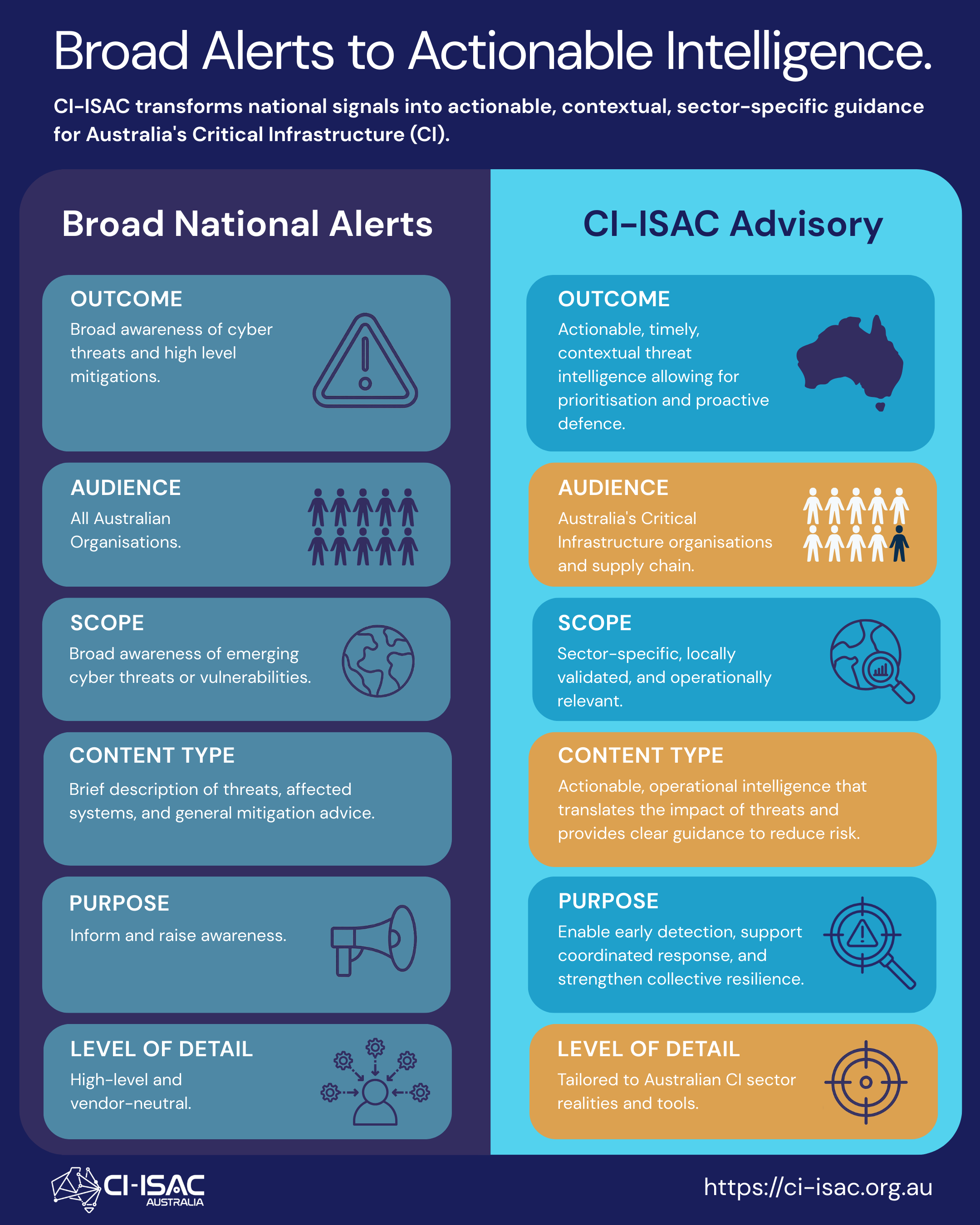
CI-ISAC supports this visibility through trusted intelligence sharing across Australia’s critical infrastructure sectors. By enabling emerging activity to be shared in a trusted environment and assessed centrally, CI-ISAC enables patterns to surface earlier and supports more informed decision-making before incidents escalate.
Continue The Conversation
If you’re exploring how broader visibility could strengthen your organisation’s approach to cyber risk, speak with CI-ISAC about how cross-sector intelligence works in practice.