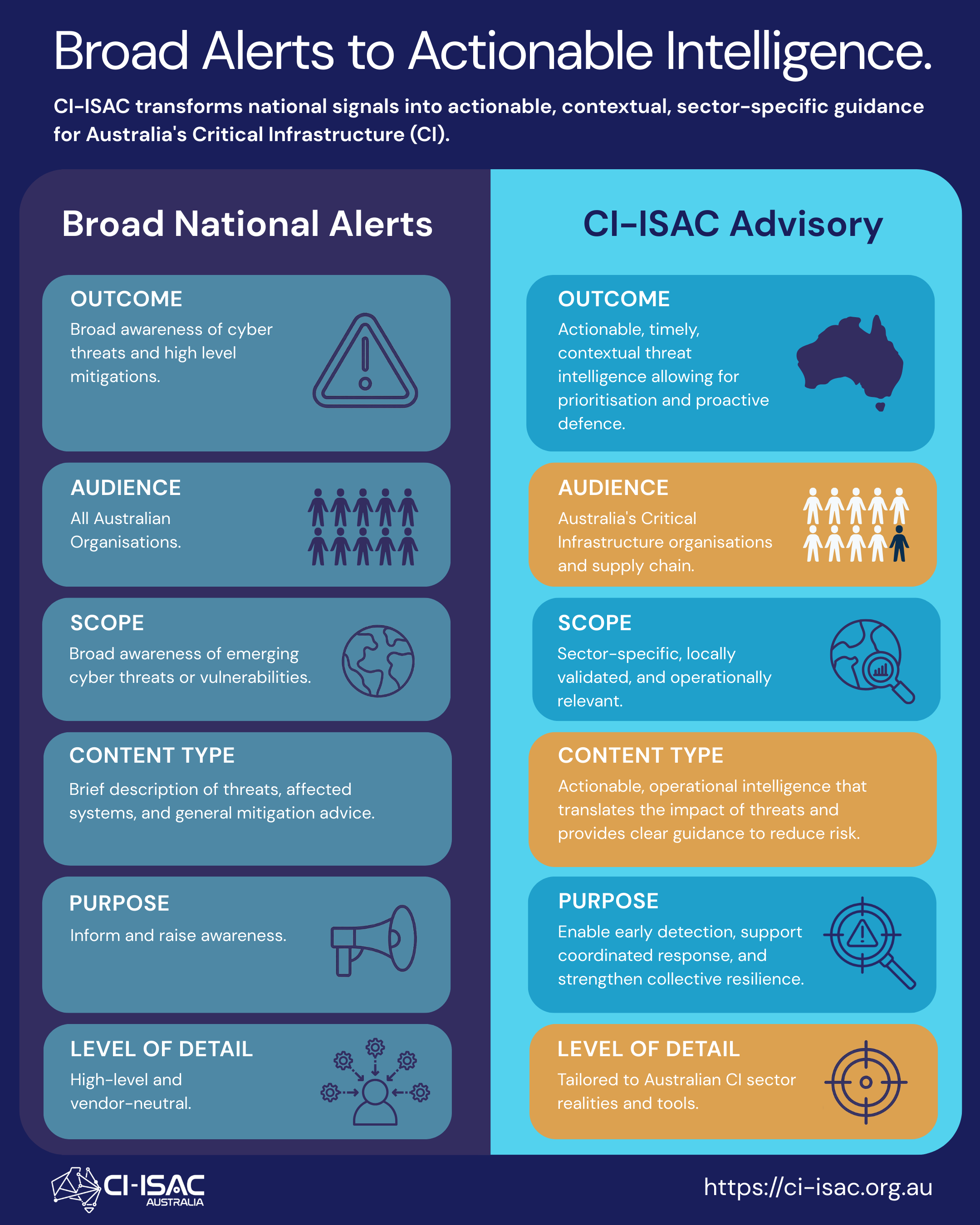

Executive teams across Australia’s critical infrastructure sectors are expected to make decisions about cyber risk, investment, and capability in a landscape that rarely feels settled. Threat activity evolves quickly, technology dependencies continue to deepen, and expectations around resilience and accountability are increasing.
Yet many of these decisions are still made with a constrained view of how risk is developing. With visibility limited to a single organisation or sector, planning is shaped by partial information, meaning what appears urgent locally may not be significant when looking at the bigger picture, while emerging risks elsewhere can remain unseen until they begin to surface closer to home.
The Limits Of Planning With A Narrow View
Within any organisation, leaders rely on a combination of operational reporting, incident data, and expert advice to guide decisions. This information is valuable, but it reflects only one perspective.
When cyber risk is assessed without insight beyond organisational or sector boundaries, it becomes difficult to judge timing, relevance, and scale. Signals may be interpreted as isolated issues rather than early indicators of broader activity, and as a result, prioritisation can become reactive, shaped by what is immediately visible rather than what is developing across the wider environment.
Over time, this narrow view increases pressure on executive decision-making. Leaders are required to commit resources and set direction without confidence that they are seeing the full picture.
Why Broader Visibility Matters For Prioritisation
Broader visibility changes how cyber risk is understood. When intelligence reflects activity across critical infrastructure sectors, it provides context that helps leaders distinguish between local anomalies and emerging trends.
This perspective supports more intentional prioritisation. Investment decisions can account for how threats are actually evolving, and capability planning can be informed by shared experience, rather than assumptions based on limited exposure. Importantly, broader visibility improves how uncertainty is managed, replacing guesswork with context and comparison.
From Hindsight To Aligned Executive Oversight and Decision Making
Patterns often become clear after incidents unfold, but in hindsight, connections between events are easier to trace. What matters for leaders is access to insights early enough to influence outcomes while options remain open.
Cross-sector intelligence provides that proactive understanding, enabling executive teams to assess how activity is developing in order to manage escalation, investment, and response with greater precision.
This broader visibility also strengthens alignment between executive oversight and operational reality. When cyber risk discussions are grounded in shared context, conversations move beyond isolated reports, governance becomes more deliberate, and direction is set with a clearer view of how risk evolves in practice.
From Retrospective Response To Cross-Sector Foresight
As the critical infrastructure sector evolves, the ability to plan with awareness beyond organisational boundaries is increasingly important. Broader visibility supports executives to make decisions that are more deliberate, better timed, and grounded in the realities of the threat landscape.
CI-ISAC supports this view through trusted intelligence sharing across Australia’s critical infrastructure sectors. By providing insight into how activity is developing beyond individual organisations, CI-ISAC helps leaders plan and prioritise risk with the right context.
If you’re considering how broader visibility could strengthen executive planning and risk prioritisation within your organisation, a conversation with CI-ISAC can help explore how cross-sector intelligence works in practice.