
The geopolitical environment Australia is navigating today has fundamentally changed the risk matrix for critical infrastructure. Trade tensions, grey zone activity, and the accelerating weaponisation of digital systems have made cyber threats a board-level strategic concern, with direct implications for the sectors that keep this country running: energy, health, finance, communications, transport, and more.
Against this backdrop, Dr Jill Slay AM’s Independent Review of the Security of Critical Infrastructure (SOCI) Act has arrived with a clear finding: the intelligence sharing model has a structural deficiency. For years, operators have reported incidents and vulnerabilities upward into government channels and received limited structured intelligence in return. Recommendation 6A of the review moves to correct that asymmetry through legislation, mandating bidirectional cyber threat intelligence (CTI) exchange between government and operators across all 11 critical infrastructure sectors.
How that mandate is operationalised, and through what institutional architecture, will determine whether this reform cycle produces a genuine national cyber defence capability or replicates the compliance-first culture the review set out to dismantle. For senior leaders accountable to boards for risk, operational continuity, and regulatory exposure, that distinction is worth understanding before the legislative drafting is complete.
Recommendation 6A: From One-Way Reporting to Bidirectional CTI Exchange
For most critical infrastructure operators, the intelligence relationship with government has historically been asymmetric. Incidents get reported up, advisories come down, and the gap between what is known about the threat environment and what operators can act on in real time has been a genuine challenge for the sector. The review acknowledges this openly and mandates bidirectional cyber threat intelligence exchange between government and operators across all critical infrastructure sectors.
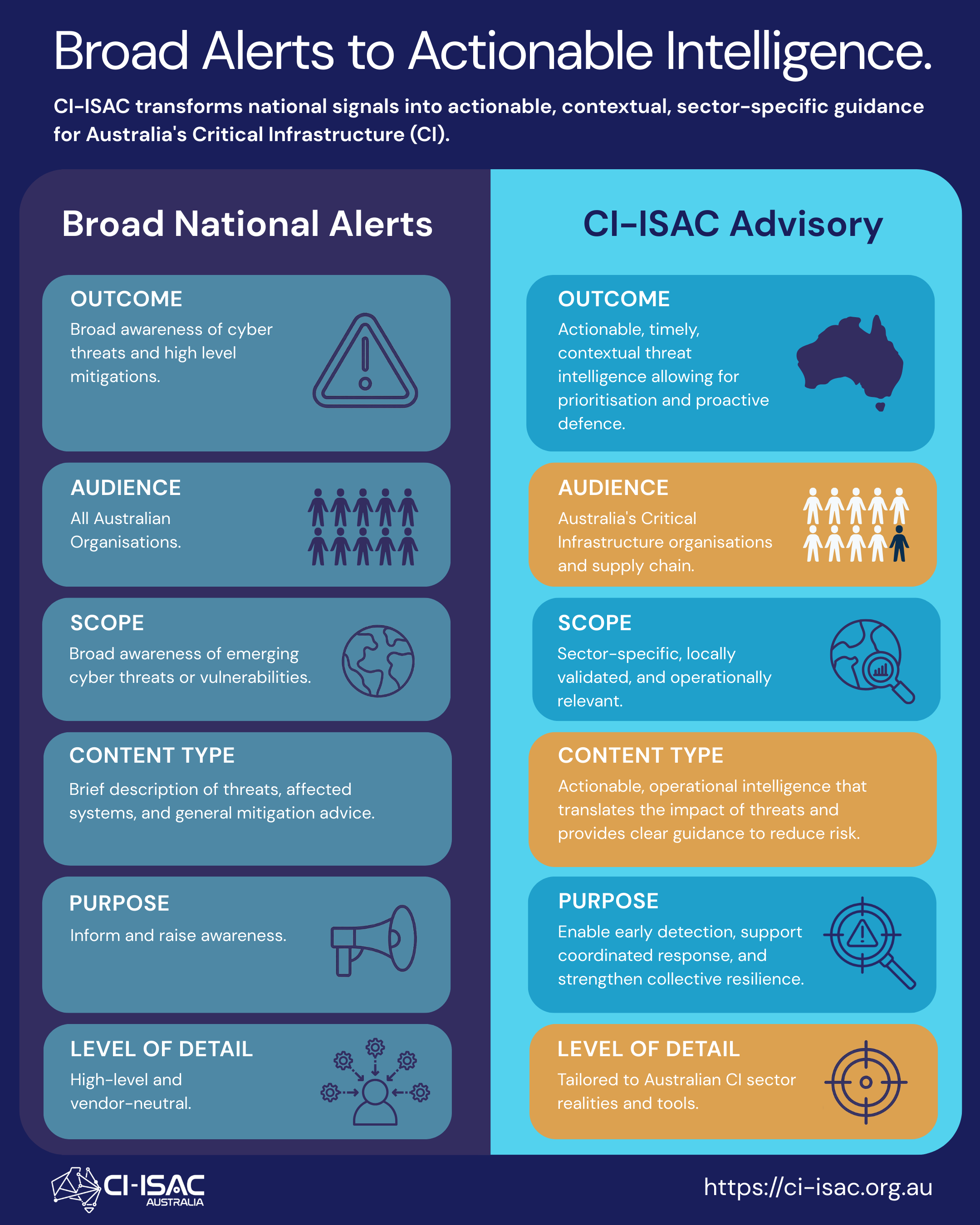
For operators, that shift matters most at the point where intelligence becomes actionable: knowing not just that a threat exists, but whether it targets your sector’s specific systems, what indicators to look for, and what to prioritise before an incident occurs.
Legislation can mandate the exchange, but contextualising that intelligence for specific sectors, translating it for different maturity levels, and distributing it at the speed operational risk demands are capabilities that sit outside what legislation alone can deliver.
Putting Bidirectional CTI Sharing Into Practice
For organisations across Australia’s critical infrastructure sectors, moving from policy obligation to operational reality means active participation in a shared intelligence picture, not just receiving advisories. Security and risk leaders already managing stretched teams and competing priorities will recognise the significance of that distinction.
In practice, that involves:
- Contributing threat sightings and incident data into a trusted network
- Consuming intelligence that has been assessed and enriched for your sector’s specific operating environment
- Integrating that intelligence into the security decisions your team is already making: what to patch first, where to focus monitoring, which supplier relationships carry unacceptable risk
When those three components work together, the security picture shifts from reactive to anticipatory, and decisions get made with the full weight of cross-sector visibility behind them. Threats that would previously have surfaced as incidents become visible earlier, as indicators identified in one sector get validated and distributed across the network before they reach others.
For organisations accountable for the continuity of essential services, that earlier warning is the operational value the SOCI Act reform is designed to institutionalise across every regulated sector.
The Legal Clarity Operators Need
Legal uncertainty has been one of the most cited reasons organisations have held back from deeper intelligence sharing. Concerns about confidentiality, regulatory liability, and what the current framework actually permits have created hesitation even among operators who understand the value of participation.
The review acknowledges this directly and recommends legislative changes to remove that ambiguity. For operators, the practical implication is that the incoming reforms are designed to make sharing safer and more straightforward, not more burdensome. Organisations that engage now, rather than waiting for post-reform clarity, are better positioned to shape how those protections are drafted and to demonstrate a proactive security posture to their boards and regulators.
The more significant shift is on the compliance side. Under the incoming penalty-based regime, demonstrated participation in sector intelligence sharing is proposed as a mitigating factor in enforcement decisions. For boards already asking hard questions about cyber risk governance, that distinction matters: organisations that have been actively participating in shared intelligence networks will be in a materially stronger regulatory position than those that engaged only after the framework was finalised.
The Case for a National, Australian-Specific Intelligence Network
When bidirectional cyber threat intelligence sharing is working as intended, the security picture across an entire sector changes. Threat sightings from one operator get validated, contextualised, and returned to every participant before those same threats reach others. Intelligence that would otherwise sit in a single organisation’s incident log becomes collective defence.
International threat intelligence provides valuable signals, but it does not consistently reflect Australian operating conditions, sector interdependencies, or regulatory context. That is why a national, Australian-specific ISAC has become increasingly important to how critical infrastructure operators build and maintain their defensive posture.
CI-ISAC Australia operates across all 11 of Australia’s critical infrastructure sectors, bringing together owners and operators from finance, health, energy, telecommunications, government, and transport to share intelligence that has been validated and contextualised for Australian conditions. What one member observes, the broader network benefits from. That collective visibility is what the SOCI Act reform is moving to formalise, and it is already operating today.
The Window to Act Is Now
Mandatory bidirectional cyber threat intelligence sharing is coming to Australia’s critical infrastructure sectors. The organisations that will be best positioned are those already participating and building the governance, the muscle, and the demonstrated posture before the legislative framework finalises around them.
The sectors that keep Australia running cannot afford to defend in isolation. CI-ISAC exists so they don’t have to.Stop defending in isolation and start operating with shared intelligence: Explore CI-ISAC membership